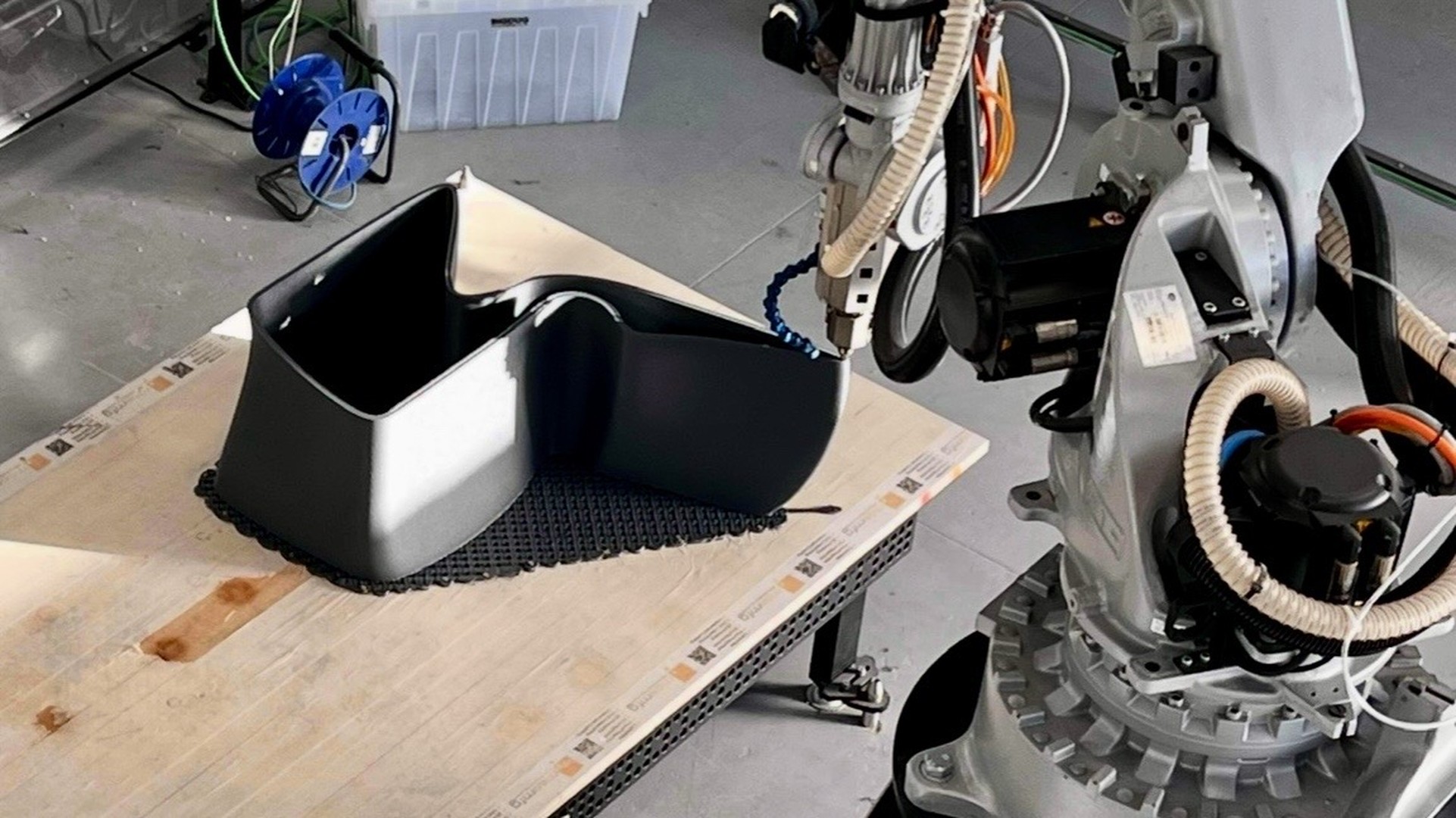
Large format additive manufacturing, or LFAM, is a technology that allows products to be built layer by layer directly from a digital design. While additive manufacturing is commonly associated with small-scale 3D printing, LFAM enables the production of full scale objects such as furniture in a single process.
This means that instead of creating multiple parts that need to be assembled, entire structures can be fabricated as one continuous piece. The result is a more integrated approach to making, where form, structure, and function are developed together rather than in separate stages.
Why is it Different ?
Working with LFAM allows us to move away from conventional production methods that rely on moulds, tooling, and multiple stages. Since the process is driven directly by digital input, changes can be made quickly without the need to rework tools or restart production setups.
Fabricating products in a single step also removes the need for assembly, simplifying the overall system. This not only reduces production time but also allows for more efficient use of materials, making the process both flexible and streamlined.
A New Approach to Furniture Design
In furniture design, achieving strength, comfort, and durability often involves combining multiple materials and components. With LFAM, we are able to approach this differently. Performance can be built directly into the structure, rather than added through layers or separate parts.
This allows us to design systems that are lightweight yet strong, with greater control over how they respond to use. By working at the level of structure, we can create products that are both efficient and responsive, without increasing material complexity.
At EcoLattice, LFAM is central to how we design and produce furniture. By using this technology with PETG, we are able to create products that are fabricated as complete systems rather than assembled components. Once printed, the product requires minimal finishing and is ready to use almost immediately.
This approach allows us to reduce production steps, avoid the need for moulds, and make better use of material. It also supports our focus on structurally driven design, where performance is achieved through geometry and form. Through LFAM, we are able to explore more efficient and adaptable ways of creating furniture that align with both performance and sustainability goals.
Team EcoLattice