Rethinking Materials in a Changing World
As conversations around sustainability continue to grow, materials are being re-evaluated not just for what they are, but for the impact they create. Traditional materials, particularly those used in mass manufacturing and cushioning systems, often rely on resource intensive processes and result in products that are difficult to recycle or disassemble. This has led to a broader shift in how materials are approached, where the focus is no longer limited to cost and performance, but extended to environmental impact and lifecycle.
Design today demands a more conscious approach, where materials are selected with an understanding of how they are sourced, processed, used, and eventually discarded. This shift is not about replacing one material with another, but about questioning the role materials play within a system and how they can contribute to more responsible design outcomes.
What Defines a Sustainable Material
A sustainable material is not defined by a single characteristic. It is not simply about being natural or biodegradable, but about how it performs across its entire lifecycle. Factors such as durability, energy consumption during production, recyclability, and the ability to be reintegrated into new systems all play a role in determining its impact.
In many cases, materials that last longer and perform efficiently can be more sustainable than those designed for short term use, even if they are bio based. This introduces a more balanced perspective, where performance and responsibility are considered together. The goal is not only to reduce harm, but to create systems where materials can exist within continuous cycles rather than linear paths of use and disposal.
Emerging Material Directions
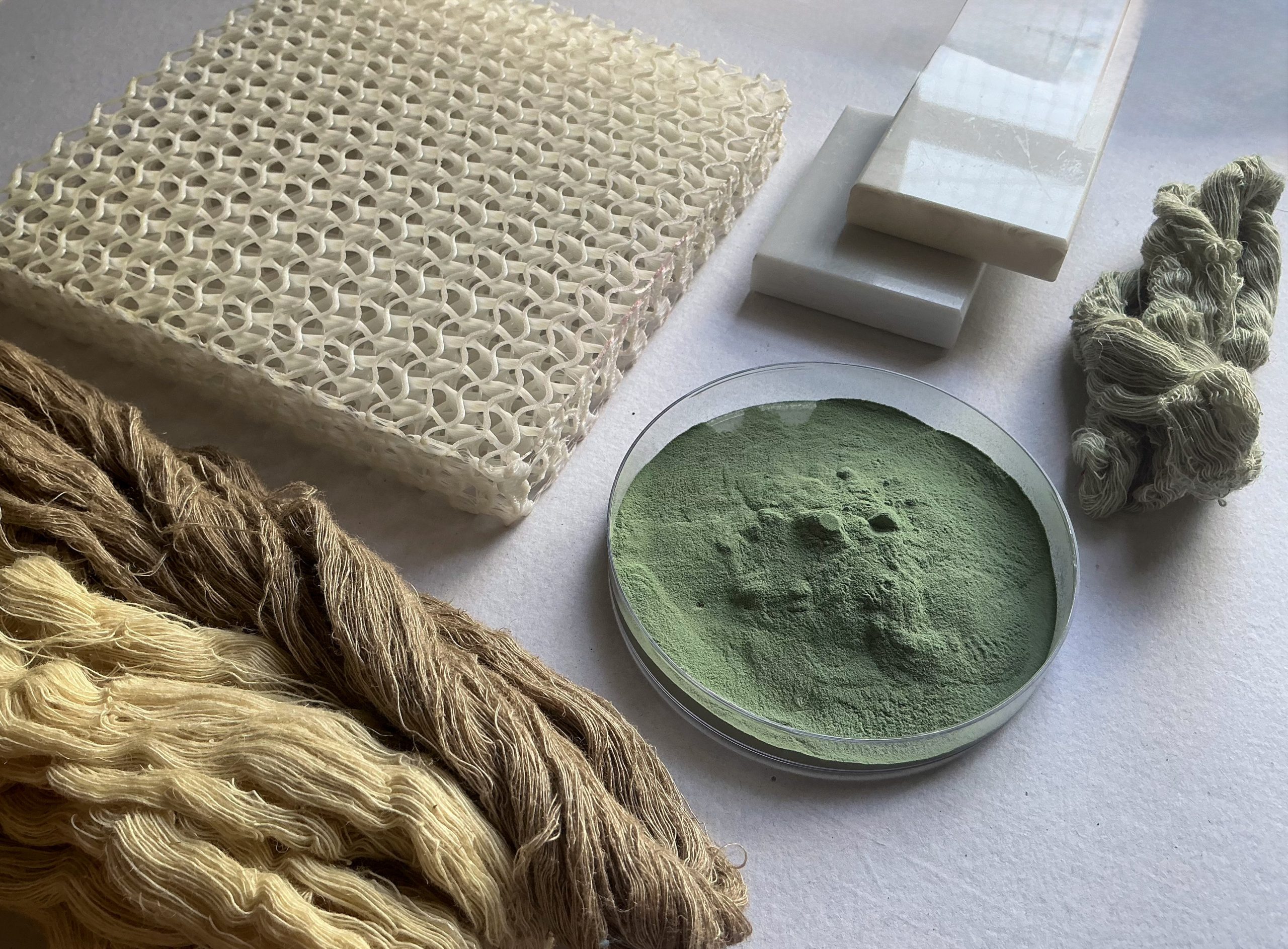
The shift toward sustainability has led to the exploration of a wide range of material alternatives. These include bio based polymers, recycled and upcycled materials, textile driven systems, and low impact composites. Each of these approaches reflects a different way of addressing the challenges of conventional materials, whether through reducing dependence on virgin resources, lowering environmental impact, or enabling better end of life solutions.
Rather than focusing on individual materials, the emphasis is increasingly on how materials function within a system. Combining different material properties, reducing the number of components, and designing for disassembly are becoming important strategies. This systems thinking approach allows for more efficient use of resources while maintaining or improving performance.
Aligning with the ecoLattice approach
This very evolving material landscape directly informs our approach to design.Instead of relying on bulk materials and layered constructions, we focus on how structure and material behavior can work together to achieve performance.
This aligns with the broader philosophy of sustainability, where reducing material use, simplifying systems, and considering lifecycle become integral to the design process. By investigating structurally driven solutions and material combinations, we aim to create products that are not only efficient and high performing, but also more responsible in how they are made and used. In this way, our exploration is not separate from the larger sustainability conversation, but part of a growing shift toward designing with greater awareness and intention.
Team EcoLattice